
The Best Metal 3D Printing Materials for Additive Manufacturing
Nearly all metal 3D printing processes rely on metal powder. Whether used as a raw material or bound in a filament, it is the essential ingredient that enables machines to additively fabricate parts. This means the availability of metal 3D printing materials in additive manufacturing must depend almost entirely on how easily the powderized form can be fused together. Aluminum powder, for example, is more difficult to meld together than steels that are much more easily bonded, and is therefore a lot less common of a metal 3D printed material.
Request a demo
The most useful metal 3D printing materials offer manufacturers the greatest value-add compared to traditional manufacturing methods. Oftentimes this stems from machinability. Hard-to-machine materials like tool steels and titanium are traditionally very tough to work with, but because machinability does not equate to printability, these metals can be made on a 3D printer with minimal labor at a fixed, low cost per part.
Let’s review some of the metal 3D printing materials available on the Markforged Metal X system, and the pros and cons that each material brings to the manufacturing process.

Stainless Steel
Stainless steel is characterized by high strength and excellent corrosion resistance. This material is used across a vast range of industries and applications from manufacturing to assistive technology. Examples of 3D printed stainless steels include the extremely corrosion resistant 316L and the heat treatable 17-4 PH Stainless Steel.
Tool Steels
As the name suggests, this class of steels is used for a variety of manufacturing tooling. Anything on a production line that cuts, stamps, molds, or forms is probably made out of tool steel. Tool steels can withstand such harsh conditions because of their high hardness, and excellent high heat and abrasion resistance. Because of these properties, tool steels are very difficult and expensive to machine, making them an ideal candidates to be 3D printed. Popular powders and filaments include A2, D2, and H13 Tool Steel.
Titanium
This metal is strong, incredibly lightweight, and heat and chemical resistant. Normally, titanium is extremely challenging to machine (contributing to its high cost), making it a great candidate for 3D printing. The most common 3D printed titanium is Titanium 64 (Ti-6Al-4V) and is used in situations when a very high strength to weight ratio is beneficial, such as aircraft.
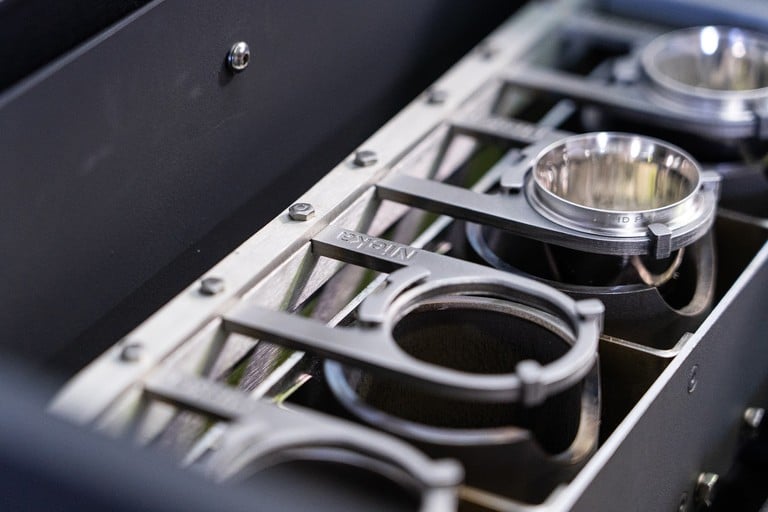
Inconel 625
While 3D printers can be used to produce parts out of common metals such as steel, they can also fabricate parts out of superalloys that are uniquely suited for extreme environments. Inconel 625 is a strong, stiff, and very corrosion- and heat-resistant nickel-based superalloy that is often used in places like turbines and rockets. Other types of Inconel, namely Inconel 718, don’t have the same heat resistance that Inconel 625 has. The material is traditionally wildly expensive to machine; conversely, Inconel can be purchased in powder form and 3D printed for a fraction of the cost, opening the door to affordable Inconel components.
Read our Metal Design Guide
Looking Forward
The current list of metal 3D printing materials is relatively short and focused on higher grade materials that are most financially beneficial to fabricate. However, as metal 3D printing matures, expect to see more and cheaper metal 3D printing filaments and powders available across different metal printing platforms. These materials, feeding off of the same cost benefits as the metals mentioned in this post, will open up new applications for metal printing and further its adoption by the manufacturing masses.
모든 블로그와 블로그에 포함된 정보의 저작권은 마크포지드에 있으며, 당사의 서면 허가 없이 어떤 방식으로든 복사, 수정 또는 채택할 수 없습니다. 당사의 블로그에는 당사의 서비스 마크 또는 상표뿐만 아니라 계열사의 상표가 포함될 수 있습니다. 귀하가 당사의 블로그를 사용한다고 해서 당사의 사전 허가 없이 당사의 서비스 마크 또는 상표를 사용할 수 있는 권리나 라이선스가 부여되는 것은 아닙니다. 당사 블로그에서 제공되는 상표 정보는 전문적인 조언으로 간주되어서는 안 됩니다. 당사는 새로운 정보, 후속 이벤트 등을 바탕으로 블로그를 업데이트하거나 수정할 의무가 없습니다.
새로운 정보를 놓치지 마세요
Markforged의 최신 컨텐츠를 편지함으로 받으시려면 구독하십시오.