
Inspection Fixtures — Traditional Machining vs Additive Manufacturing

Traditionally manufacturing inspection fixtures
Inspection is a routine component of the manufacturing process; as parts come off of the production line, some are examined to ensure accurate dimensions. This process requires specialized workholding. Two examples include CMM fixtures and check gauges.
A coordinate-measuring machine (CMM) is a precision tool that probes multiple points on a part to determine if the geometry is within specification. Check gauges are another form of inspection fixture used to quickly and accurately determine if parts are satisfying basic tolerances. If the part fits into the gauge, the part is within specification.
These fixtures need to satisfy stiffness and precision requirements, which traditionally would mean they would be custom-machined out of aluminum. However, the process is expensive and depletes valuable shop time. As the effort increases with the complexity of machined parts, it becomes even more cumbersome to manufacture inspection fixtures that must contain intricate geometries.
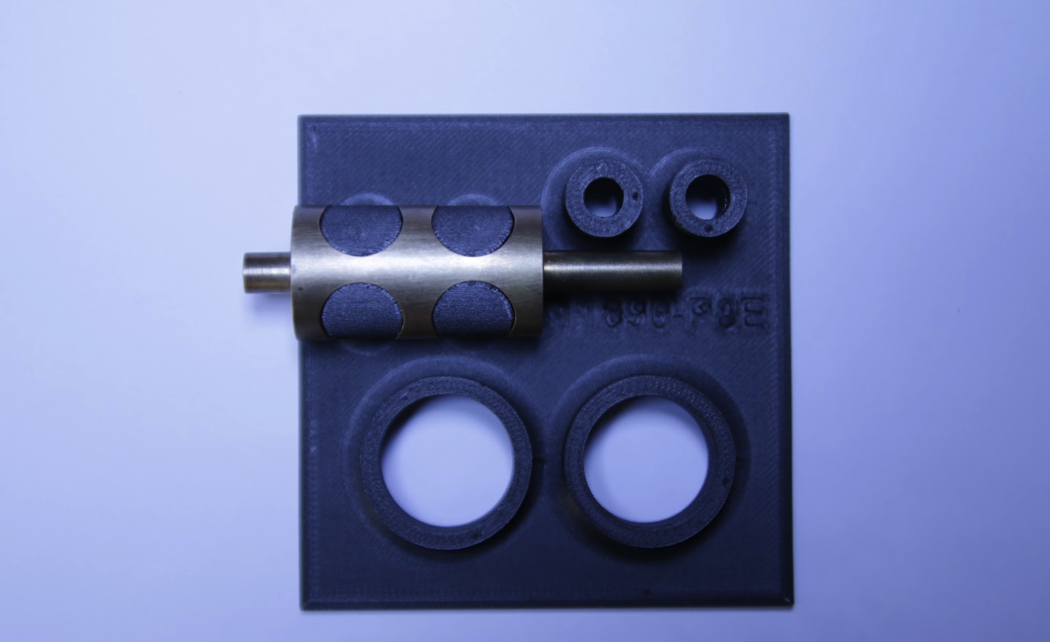
Why machining complex parts is hard
With 3-axis mills, complexity is already restricted by machine-specific limitations, such as the inability to perform undercuts. This renders certain geometries unproducible and forces you to constrain the complexity of your design to those restrictions.
After your part is designed for traditional manufacturing, it’s not ready to be fabricated quite yet. If a fixture is to be machined, it must be prepared in CAM beforehand. This process involves selecting which tools will be used to cut the stock and planning out the paths for each of those tools. Because more complex geometries often require a higher number of cutting operations, more intricate parts make for more work in CAM, and more skilled labor spent on fabricating the part. Alternatively, utilizing composite 3D printing to manufacture fixtures allows you to produce stiff, precise workholding while cutting out the expensive, time-consuming CAM process. Eiger, Markforged’s slicing software, takes care of all of the preparation; so all you have to do is design, then start the print. Higher geometric complexity can be printed with no extra effort, allowing for intricate, form-fitting fixtures to be produced at a lower cost.
To learn more about how composite 3D printed inspection fixtures help save time and money, watch the webinar. Or check out our case study on how JJ Churchill used Markforged printers to produce CMM fixturing 70% faster for 80% less cost.
Request a free sample part to test the strength of our materials!
所有博客和博客中包含的信息版权均归 Markforged 公司所有,未经我们的书面许可,不得以任何方式复制、修改或采用。我们的博客可能包含我们的服务标志或商标,以及我们附属公司的服务标志或商标。未经我们事先许可,您使用我们的博客并不构成您使用我们的服务标记或商标的任何权利或许可。Markforged 博客中提供的信息不应被视为专业建议。我们没有义务根据新信息、后续事件或其他情况更新或修订博客。
不错过任何一篇文章
订阅以在您的收件箱中获取新的 Markforged 内容